 OPENTHYMOS
Cognition proposes.
The runtime governs.
The ledger records.
An AI agent runtime where the model can never act on its own. Every effect passes through a typed proposal, a signed capability writ, and an append-only ledger you can replay and verify — local-first, your keys never leave your machine.
Stable · release notes
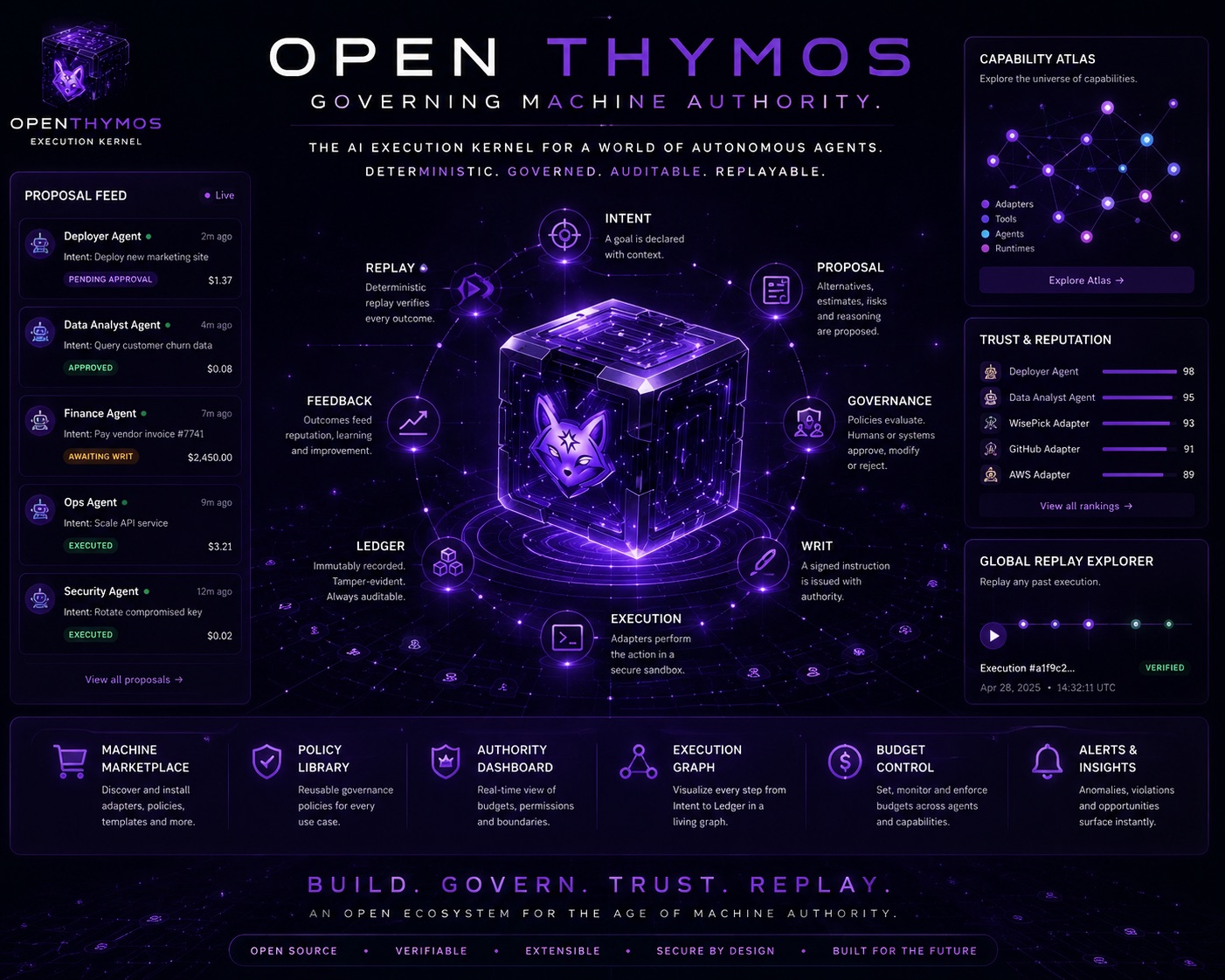
Governed AI runtime
The model never holds the keys.
Governed
The model proposes. The runtime decides.
Cognition enters the system through one narrow contract: emit intents. Authority, policy, and execution are runtime concerns — not model concerns.
Auditable
Every effect is a ledger event.
Commits, rejections, approvals, delegations, and branches are all written to the same append-only, content-addressed ledger. Nothing is out-of-band.
Replayable
World state is a committed delta projection.
Replay recomputes the world by folding committed deltas in order. It verifies the hash chain, sequence continuity, and compiler version — without calling providers.
Desktop control center
Chat with the agent.
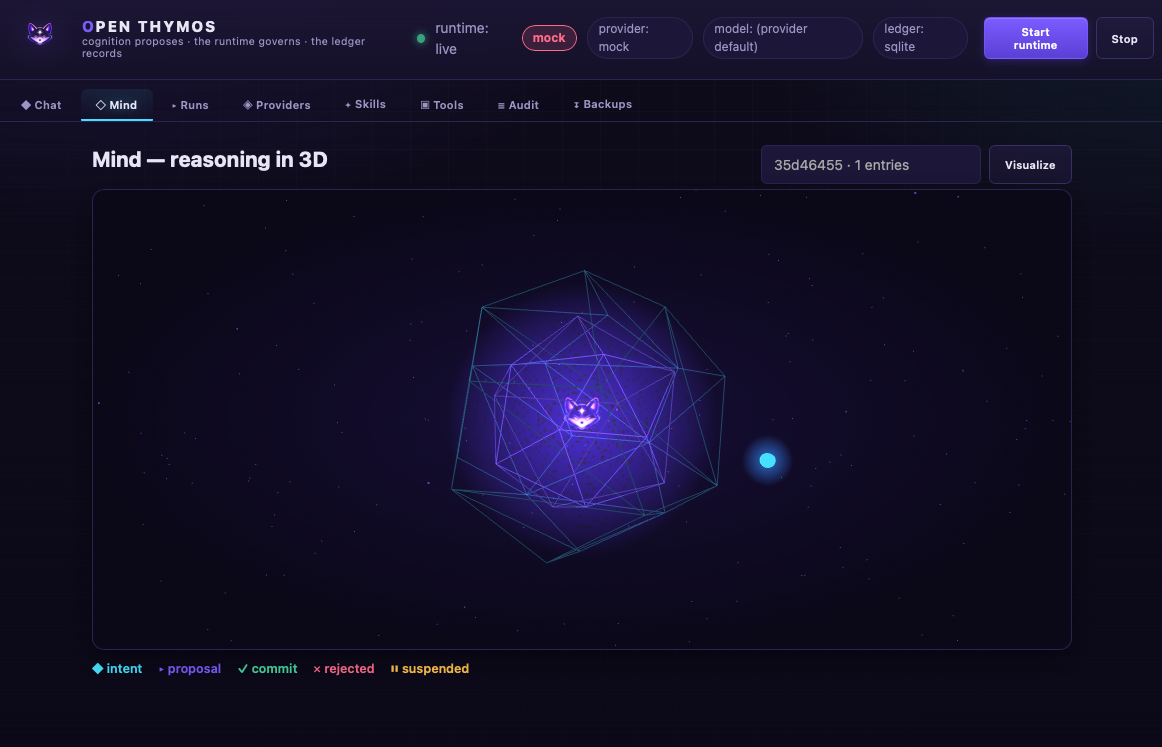
Watch it think in Mind.
The desktop app is a local-first control center: chat drives governed runs, Mind renders the live reasoning graph — every node a real runtime record — and Runs, Audit, and Backups expose the ledger underneath. Connect Claude, OpenAI, Ollama, LM Studio, or any OpenAI-compatible model; keys stay on your machine.
- Approve or deny risky actions before they run
- Live status: planning, executing, awaiting approval
- One-click audit trail and replay verification
CLI + runtime
The same governed runtime,
in your terminal.
thymos drives the identical runtime the desktop uses —
same providers, same storage, same governance. Run tasks and watch
Intent → Proposal → Commit stream live, approve
suspended actions inline, and script everything with
--json.
curl -fsSL …/scripts/get.sh | sh # installs thymos + thymos-server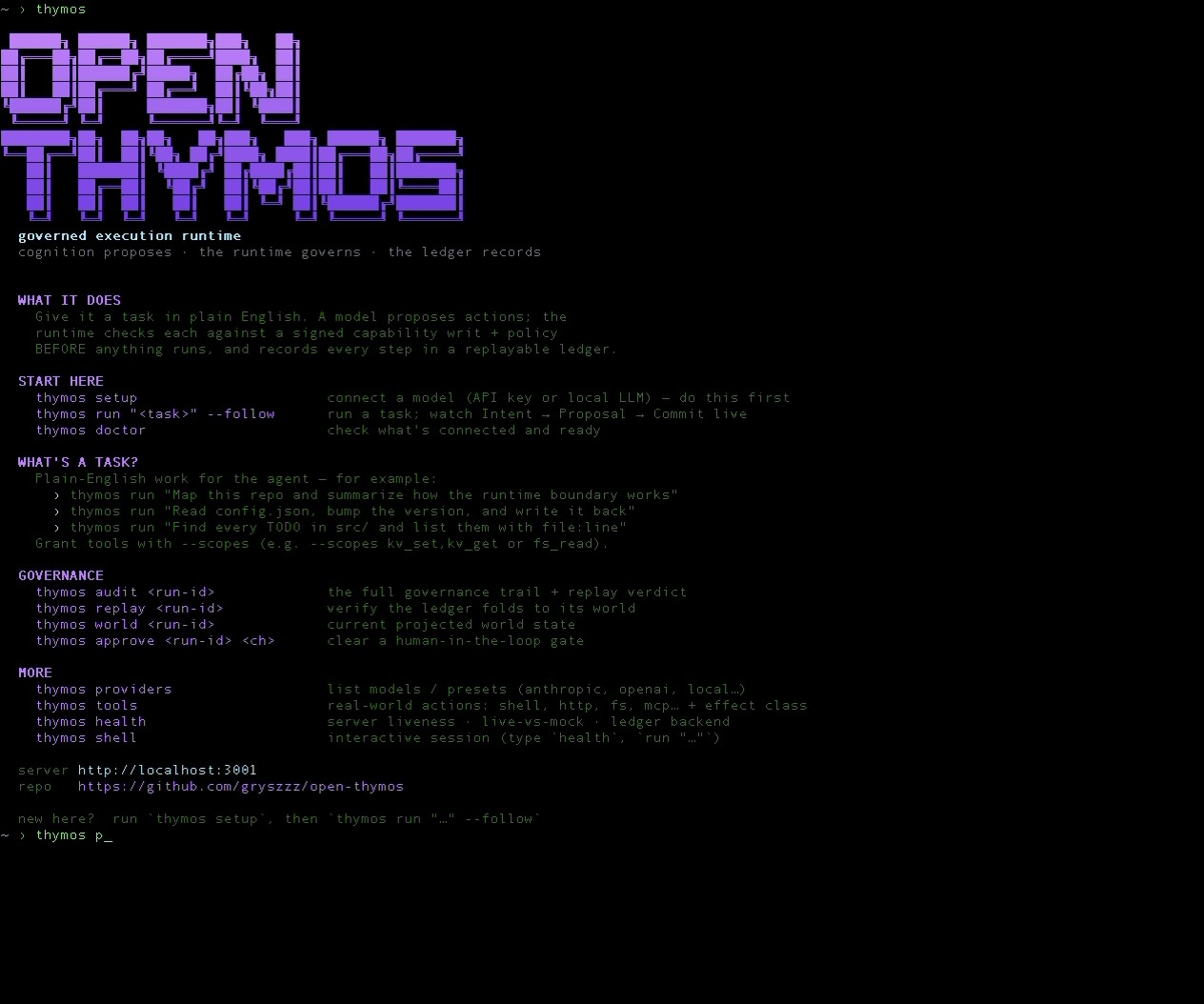
Skills · tools · grants
Authority is granted, never assumed.
Skills
Reusable, authority-narrowing templates.
Binding a skill can only shrink what a run may do — tools intersect, ceilings AND, budgets take the minimum. Never widen.
Typed tools
Capabilities are contracts, not blobs.
Every tool declares schema, effect class, and risk before it can execute — built-in Rust tools, JSON manifests, and MCP bridges alike.
Grants & approvals
Dangerous actions pause for you.
High-risk tools like shell suspend for an explicit
operator sign-off — in the desktop or inline in the CLI — even when
the writ permits them.
Audit & replay
Prove what happened. Replay it.
Every run leaves a hash-chained trail; replay folds it back into the same world state — without calling a provider or re-running a tool.
Download stable release
One official download. Two ways to run it.
Everything ships from the latest stable release — release notes and checksums there. Nightly dev builds are separate and clearly marked.
thymos and thymos-server. Scriptable, server-ready.
curl -fsSL https://raw.githubusercontent.com/gryszzz/open-thymos/main/scripts/get.sh | shExecution grammar
Intent → Proposal → Commit
Three types. One direction. No shortcuts.
Intent
Emitted by cognition. Carries no authority. Content-addressed by
blake3(canonical_json(body)).
Proposal
Compiled by the runtime from (Intent, Writ, World, ToolRegistry, PolicyEngine).
Binds tool contract, budget projection, and policy trace.
Commit
The only record that mutates world state. Contains structured delta, observed tool output, writ id, proposal id, and compiler version.
Capability writ
Ed25519-signed authority document. Bounds tool scopes, budgets, time windows, effect ceilings, and delegation depth.
Policy engine
Pure function (Intent, Writ, World) → Permit | Deny | RequireApproval.
Decision recorded in the proposal trace.
Execution ledger
Append-only, parent-chained trajectory history. Root, commit, rejection, pending approval, delegation, and branch entries.
Replay verifier
Proves hash chain integrity, sequence continuity, and world projection correctness. Cannot call providers or execute tools.
Provider boundary
Providers emit intents. They cannot execute, authorize, or delegate. Provider identity grants no authority.
Five runtime guarantees
Not conventions. Invariants.
These are checked structurally by the runtime, recorded in the ledger, and verifiable by replay. They are not documented promises.
A valid ledger can be folded into the same world projection under the recorded commit sequence.
Cognition cannot execute tools or mutate state directly. The provider boundary is enforced at the type level.
Only staged proposals may reach the tool boundary. Only commits may mutate projected world state.
Tool scopes, budgets, time windows, effect ceilings, tenant boundaries, and delegation bounds are checked before execution.
Policy decisions are recorded as proposal traces and cannot be erased by a client surface.
Run it locally. Govern everything.
Download the desktop app or the CLI, connect a model, and watch every action pass through Intent → Proposal → Commit.